
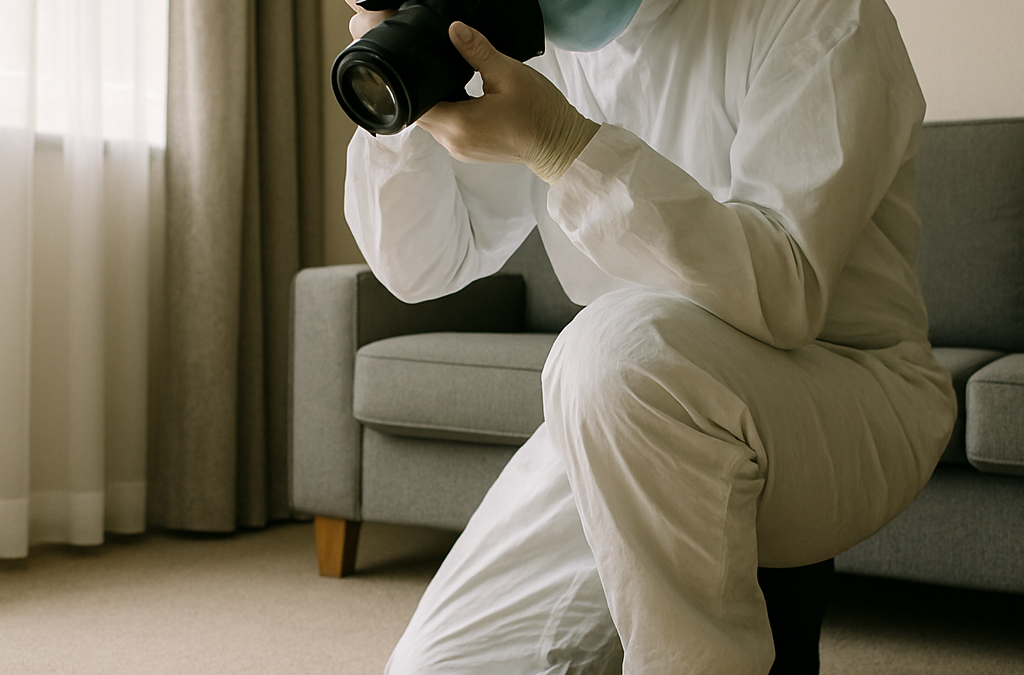
You hear “Crime Scene Investigation,” and you might think of a dramatic TV reveal, a solved case in 60 minutes. But in reality, the most powerful moment isn’t a zoom-in on a single clue. It’s the profound, deliberate silence of a secured scene—the quiet space where science and methodology begin the long, careful work of speaking for the victim. Real CSI isn’t about speed; it’s about an immutable chain of integrity that connects a single fiber at a scene to a verdict in a courtroom.
This is the true, step-by-step process of Crime Scene Investigation, and understanding its rigor shows why it’s the irreplaceable cornerstone of justice.
Why CSI Isn’t What You See on TV (And Why That Matters)
Before we walk through the steps, let’s clear the air. Hollywood prioritizes drama. Real CSI prioritizes integrity, contamination control, and documentation. There’s no one brilliant detective doing it all. It’s a team of specialists—evidence photographers, latent print examiners, bloodstain pattern analysts—each following a strict protocol. Why? Because every case hinges on the admissibility of evidence. A single procedural misstep can unravel an entire investigation, allowing the guilty to walk free. This process is the defense against that.
The 7-Step CSI Protocol: A Dance of Discipline
This is the standard framework, a dance where each step protects the one before it.
Step 1: Secure and Isolate
The moment the first responder declares a scene, the clock starts. The primary goal is to preserve the scene exactly as it was found. This means:
-
Establishing a wide perimeter with tape and barriers.
-
Creating a single access point for logged personnel only.
-
Documenting everyone who enters or exits (the “scene log”).
Think of it as: Placing a giant, invisible bubble over the area. Nothing gets in or out without being recorded.
Step 2: Reconnaissance and Initial Walkthrough
The lead investigator does a preliminary walkthrough—often following a predetermined path to minimize disturbance—to formulate a plan of attack. They are asking:
-
What is the apparent nature of the crime?
-
What are the obvious points of entry/exit?
-
Where is the focal point of the incident?
-
What evidence is transient (like a smell, temperature) and needs immediate collection?
Step 3: The Systematic Documentation
Now, the scene is photographed, sketched, and video recorded before anything is touched.
-
Photography: Starts with wide-establishing shots, then moves to mid-range, and finally close-ups with scales and evidence markers. Every item is captured in context.
-
Sketches: A rough sketch is made, noting dimensions, locations of evidence, and fixed points (like a door). Later, a final, scaled sketch is produced for court.
-
Notes: A continuous, narrative log records actions, observations, and the condition of evidence
Step 4: The Methodical Search for Evidence
With a plan in place, the team executes a systematic search pattern to ensure no area is missed. Common patterns include:
-
Spiral: Moving inward or outward from a focal point.
-
Grid: A double-line search, effective for large outdoor areas.
-
Strip/Line: Team walks in parallel lines across a scene.
-
Zone: Dividing a room or vehicle into sections for different specialists.
Evidence is located, marked with a numbered placard, and logged before collection.
Step 5: The Critical Collection & Packaging
This is where forensic science truly begins. Each type of evidence requires a specific, contamination-free collection method:
-
Biological (Blood, Hair): Air-dried, placed in paper bags (plastic causes mold).
-
Fibers/Trace: Collected with tweezers or adhesive lint rollers.
-
Ballistics: Picked up by the edges to preserve striations.
-
Electronics: Placed in anti-static, Faraday bags to preserve data.
-
Latent Prints: Lifted with tape or chemicals and placed on print cards.
Every container is labelled with unique case info, item number, collector’s name, date, and time. This starts the “Chain of Custody”—a legally mandated paper trail every person who handles the evidence must sign.
Step 6: Final Survey and Release
Before releasing the scene, the team conducts a final walkthrough. They review documentation, double-check that all equipment is collected, and ensure no evidence was overlooked. Only when the lead investigator is satisfied is the scene released back to the property owner or agency.
Step 7: Submission to the Lab & Analysis
The field work is complete, but the investigation is just transitioning. Evidence is submitted to a forensic lab with explicit requests (e.g., “DNA analysis on item #4, compare to suspect”). The CSI team’s meticulous work now enables the lab scientists to do theirs without questions about the evidence’s origin or integrity.
The Unseen Importance: Why This Process is Everything
The painstaking nature of this process isn’t bureaucratic—it’s the bedrock of justice.
-
1. It Preserves Constitutional Rights: Proper CSI ensures evidence is collected legally, upholding the 4th Amendment (unreasonable search and seizure) and the 6th Amendment (right to a fair trial).
-
It Establishes Objective Facts: In a world of narratives and biases, physical evidence is stubborn. It can corroborate a witness, exonerate the innocent, or irrefutably place a suspect at a scene.
-
It Builds an Unassailable Case for Court: A clear chain of custody and thorough documentation allow a prosecutor to present evidence that is difficult for the defense to challenge on procedural grounds.
-
It Provides Closure for Victims and Families: While not immediate, a methodical investigation represents a systematic pursuit of truth and accountability, which is a fundamental part of societal healing.
The Final Word: A Silent Testimony
Crime Scene Investigation is, at its heart, an act of respect. Respect for the victim, for the truth, and for the legal process itself. It understands that justice is not a product of intuition, but a structure built piece by piece, fiber by fiber, photo by photo.
It’s the silent, meticulous work behind the yellow tape that gives a voice to the evidence and, ultimately, speaks for those who no longer can.
What element of forensic science fascinates you the most? Is it digital forensics, trace evidence, or the psychology of a crime scene? Share your thoughts in the comments below—let’s discuss the real-world science that builds the cases you hear about in the headlines.
P.S. Want to see the difference between Hollywood and reality? Check out our next post where we break down the “Top 5 CSI Myths Debunked by Real Forensic Experts.”