
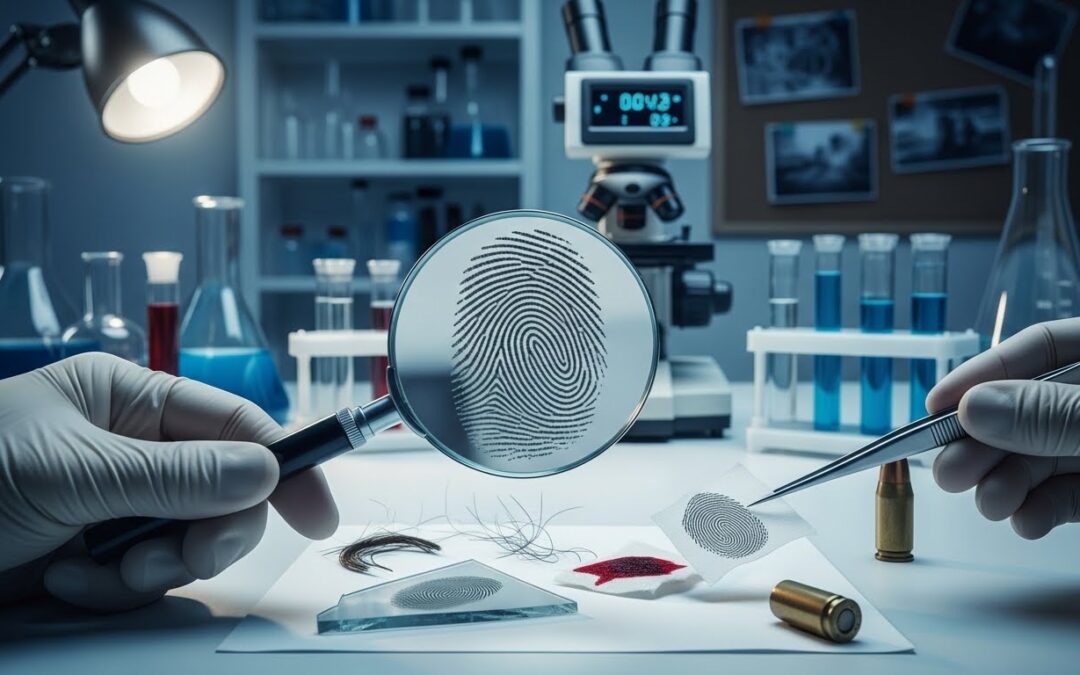
Fingerprint analysis is a cornerstone of forensic science, relying on the unique, permanent ridge patterns on human fingers to link individuals to crime scenes or objects with high degrees of certainty. This process combines meticulous collection techniques, standardized comparison methods, and rigorous courtroom protocols to ensure reliability and admissibility.
Fingerprint fundamentals
Human fingerprints form unique patterns of friction ridges during fetal development, remaining unchanged throughout life except by injury, and differing even between identical twins. Three main pattern types—loops (60-65% of prints), whorls (30-35%), and arches (5%)—provide the broad classification, while finer details called minutiae (ridge endings, bifurcations, dots) enable individualization.
Latent prints (invisible traces from sweat, oils, or contaminants) are the most common at crime scenes, requiring enhancement for visibility, unlike patent (visible) or plastic (impressed) prints. Forensic examiners, trained over years, use these patterns to compare unknown scene prints against known exemplars from suspects or databases.
Collection methods at crime scenes
Retrieval starts with surface assessment: non-porous surfaces (glass, metal) use black or magnetic powders brushed on to adhere to residues, followed by lifting with tape or gelatin. Porous surfaces (paper, cardboard) often require chemical developers like ninhydrin, which reacts with amino acids to produce purple stains, or iodine fuming for temporary visualization.
Advanced non-destructive techniques include cyanoacrylate fuming (super glue) for latent prints on varied surfaces and laser-induced fluorescence for trace detection on challenging materials like paper, exciting residues to emit light without altering evidence. Each method preserves the print for photography, documentation, and transport under chain-of-custody controls to avoid contamination.
The ACE-V analysis process
Fingerprint examiners follow the ACE-V protocol: Analysis (assess print quality, clarity, and minutiae quantity), Comparison (side-by-side overlay of unknown and known prints using magnifiers or software to align patterns), Evaluation (determine if they originate from the same source—identification, exclusion, or inconclusive), and Verification (independent review by another examiner).
This method emphasizes objective ridge counting, minutiae alignment, and sequence consideration, rejecting subjective “gut feel” in favor of reproducible criteria. Digital tools like AFIS (Automated Fingerprint Identification Systems) scan and search databases but require human verification for final conclusions, as algorithms alone cannot account for distortion or partial prints.
Reliability and error rates
Decades of research affirm fingerprints’ uniqueness and persistence, with error rates in controlled proficiency tests below 1% for experienced examiners, though real-world factors like poor print quality, pressure distortion, or background clutter can lead to inconclusive results in 20-30% of cases. The 2009 NAS report highlighted subjectivity risks, prompting standards like blind verification and peer review to minimize cognitive bias.
Statistical models now quantify match rarity (e.g., trillions-to-one odds for 12-16 matching minutiae), but courts demand examiners articulate limitations, such as non-absolutism (“source identification” vs. “100% proof”). Ongoing NIST studies refine these metrics, confirming ACE-V’s foundational reliability when properly applied.
Courtroom use and testimony
In court, fingerprint evidence is presented via enlarged photos, charts overlaying matched minutiae, and expert testimony explaining collection, analysis, and match strength without overclaiming certainty. Daubert/Frye standards require demonstrating method reliability, error rates, and peer acceptance, positioning fingerprints as Class 1 (pattern) + Class 2 (minutiae) evidence.
Examiners testify to inclusions/exclusions, not probabilities alone, addressing challenges like partial prints or defense claims of fabrication through chain-of-custody logs and lab protocols. High-profile cases, from the 1910s Drayton Thomas conviction to modern database hits, underscore its role in thousands of identifications annually, though it complements—not replaces—other evidence like DNA or alibis.
Modern advancements and challenges
Digital enhancements like 3D scanning and hyperspectral imaging detect faint prints on textured surfaces, while AI assists initial screening but defers to human judgment for nuanced evaluations. Challenges persist with touchless sensors, aged/degraded prints, and porous substrates, driving innovations like scanning Kelvin probe for simultaneous fingerprint and DNA recovery.
For business contexts like security audits or legal consulting, understanding these evolutions ensures teams prioritize compatible evidence collection, avoiding common pitfalls like over-reliance on one print or ignoring verification steps.
Key myths debunked
Myth: Fingerprints never lie or err. Reality: Poor quality or examiner error can mislead, mitigated by protocols; no method is infallible. Myth: One print solves cases. Reality: Courts demand corroboration for convictions beyond reasonable doubt.
Strategic implications for professionals
Legal teams benefit by scrutinizing examiner qualifications, print quality reports, and verification records to challenge weak evidence proactively. Risk advisors apply fingerprint principles to incident protocols, ensuring sites preserve latent traces until experts arrive. For deeper integration into case strategy or training, consider a forensic evidence audit tailored to your operations