You’ve seen it a hundred times: the brilliant investigator gets a DNA match in 60 seconds, the single fingerprint cracks the case, and the lab always has a magical answer. But what happens when you ask actual forensic scientists about their Hollywood portrayal? The reality of crime scene investigation is far more complex, nuanced, and frankly, less glamorous than TV suggests. These myths aren’t just harmless entertainment—they’re creating what courts now call “the CSI Effect,” where jurors expect forensic miracles. Let’s separate Hollywood fiction from crime lab fact.
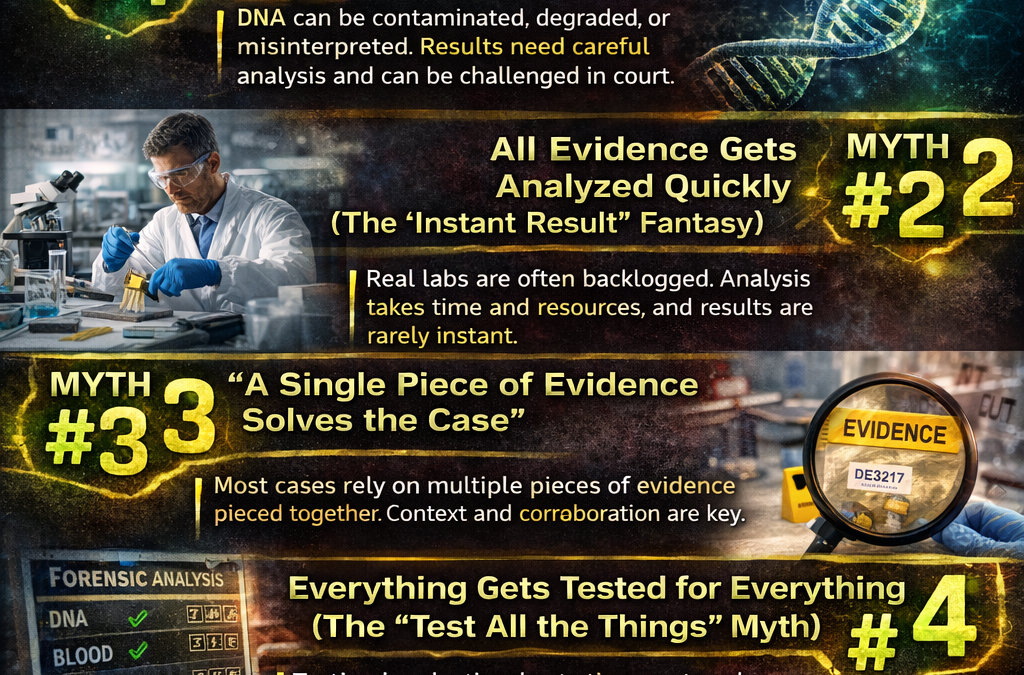
Myth #1: “DNA Evidence is Infallible and Always Conclusive”
The TV Version: A perfect match appears on a glowing screen, definitively identifying the killer.
The Expert Reality: “DNA is a powerful tool, but it’s not a magic bullet.” In reality:0
-
Mixtures are common: Evidence often contains DNA from multiple people, making interpretation complex and sometimes probabilistic (“this DNA profile is 10,000 times more likely if it came from the suspect than an unrelated person”).
-
Degradation happens: DNA breaks down in heat, moisture, or sunlight.
-
Transfer is tricky: Secondary transfer (your DNA gets on an object you never touched) can create misleading results. You could be implicated simply because you shook the killer’s hand earlier.
The Takeaway: DNA is statistical evidence, not absolute proof. It tells a compelling story about probability, not certainty.
Myth #2: “All Evidence Gets Analyzed Quickly (The ‘Instant Result’ Fantasy)”
The TV Version: Lab results pop up during a commercial break.
The Expert Reality: “The backlog is real, and it’s massive,” Most public crime labs have backlogs ranging from weeks to over a year. Why?
-
Resource constraints: Labs are chronically underfunded and understaffed.
-
Priority triage: Violent crimes take precedence. Your burglary case might wait months for DNA analysis.
-
Proper procedure: Rushing causes contamination and errors. A single DNA extraction can take 8 hours alone, not counting analysis and review.
Myth #3: “A Single Piece of Evidence Solves the Case”
The TV Version: The one fiber, the lone hair, the perfect fingerprint wraps everything up.
The Expert Reality: “Forensic science builds a web of inferences, not a single silver bullet.” In real investigations:
-
Corroboration is king: A fingerprint places someone at a scene, but doesn’t say when or why. It needs supporting evidence—witnesses, motive, digital records.
-
Context matters: A fiber match means the fibers could have a common source, not that a sweater was definitely at the crime scene.
-
The “One-off” is rare: “Competent defense attorneys will shred a case built on one piece of evidence,”. Successful prosecutions weave multiple forensic threads together.
Myth #4: “Everything Gets Tested for Everything (The ‘Test All the Things’ Myth)”
The TV Version: Every surface gets swabbed, every particle gets analyzed by every instrument.
The Expert Reality: “Testing is expensive, destructive, and strategic,”. Labs operate on triage:
-
Destructive testing: Once you test an item for DNA, you can’t test it for gunshot residue. Choices must be made.
-
Cost prohibitions: A full DNA analysis costs $500-$1,500 per sample. Testing 100 items from a scene isn’t feasible.
-
The “Fishing Expedition” problem: Without a hypothesis, indiscriminate testing rarely helps. “You need to ask a specific question of the evidence,” says Dr. Kobilinsky.
Myth #5: “Forensic Experts Never Make Mistakes or Have Biases”
The TV Version: The stoic, perfectly objective scientist delivers unquestionable truth.
The Expert Reality: “We’re human,”. The Innocence Project’s work has revealed how forensic errors and cognitive biases contribute to wrongful convictions:
-
Context bias: Knowing details of the case (e.g., “the suspect confessed”) can unconsciously influence how evidence is interpreted.
-
Human error: Mislabeling samples, contamination, or simple mistakes happen even in accredited labs.
-
Disagreement exists: Unlike TV’s definitive pronouncements, qualified experts can honestly disagree on interpreting the same evidence. This is why defense has the right to its own forensic experts.
The Real Impact: Why These Myths Matter Beyond TV
The “CSI Effect” has tangible consequences in real courtrooms:
-
Jurors expect forensic evidence in every case and may undervalue strong circumstantial evidence.
-
They overestimate what forensics can prove, leading to unreasonable doubt when reality doesn’t match TV.
-
Prosecutors now often give “negative evidence” instructions to juries, explaining why certain tests weren’t done.
The bottom line, “Forensic science is the best tool we have to answer specific questions about physical evidence, but it’s a human enterprise with limitations. It’s not magic—it’s methodical, slow, and always part of a larger investigative picture.”
Have you served on a jury or been surprised by the reality of forensic science? Which of these myths shocked you the most? Share your experience in the comments below—let’s discuss how we can better educate the public about real forensic science.